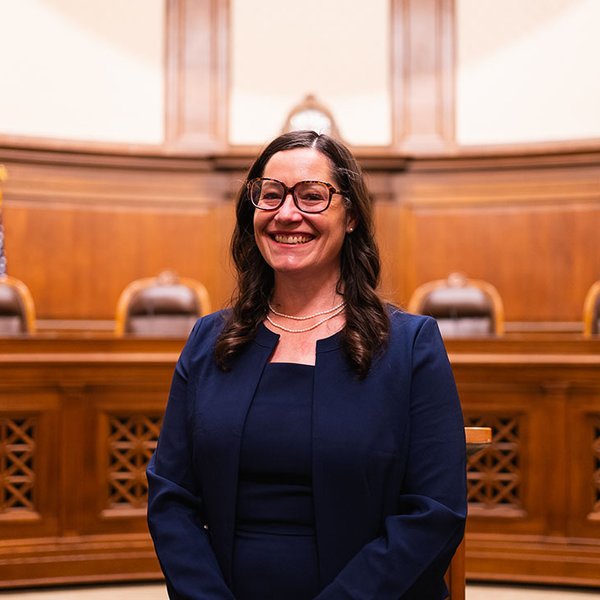
Colleen Melody
Justice, Washington Supreme Court
- Seat
- Position 1 — Yu seat
- Appointing authority
- Gov. Bob Ferguson (November 2025)
- Background
- Civil Rights Division Chief at the WA Attorney General's Office. About 20 years in civil rights enforcement.
- Reported endorsements
- Gov. Ferguson; sitting WA Supreme Court justices; retired justices Mary Yu, Barbara Madsen, Gerry Alexander, Bobbe Bridge; King County Bar; Seattle Times editorial board (July 2026 endorsement); U.S. Rep. Pramila Jayapal. Clark County Democrats.
- Fundraising
- $242,642 raised as of Sep 10, 2026
What the record actually shows
Facts pulled from public sources: who appointed them, what they did before, what they've said or written, who's backing them. We're not predicting any vote. Why these categories?
-
Who put her on the court
Gov. Bob Ferguson appointed her in November 2025. As Attorney General, Ferguson defended the capital gains tax all the way to the state Supreme Court.
-
Her background
Career civil rights lawyer. About 20 years prosecuting discrimination cases for the state. No tax law in her resume.
-
How she talks about the law
Campaign materials emphasize equity and access to justice. She has cited Justice Elena Kagan as an influence. She does not describe herself as a textualist.
-
What she has said about Culliton
Nothing directly. No published opinions, articles, or campaign statements on the 1933 ruling.
How this candidate is likely to rule, and why.
Colleen Melody's path to the bench runs straight through the office that fought hardest to keep the capital gains tax alive.
She spent a decade leading the Wing Luke Civil Rights Division of the Attorney General's office, the same office that defended the capital gains tax in Quinn all the way to the state Supreme Court, and she was Gov. Ferguson's first judicial appointment in November 2025.
That appointment coalition is the clearest available signal: Ferguson signed ESSB 6346 and his administration treated the millionaires' tax as a constitutional project, not just a legislative one.
Melody herself has described her judicial approach as one of curiosity and openness, beginning each case 'brand new,' and has cited structural analysis and deep doctrinal reading as her methods.
She graduated first in her class at UW Law, clerked, and spent roughly 20 years in enforcement litigation rather than tax or appellate doctrine work, which means her ESSB 6346 ruling is more likely to be shaped by institutional coalition and general constitutional orientation than by independent Article VII analysis.
On a court asked to scrap or preserve Culliton, she is firmly in the coalition that brought the case to that moment.
-
UW Law valedictorian and civil rights enforcement record
Melody graduated first in her class from the University of Washington School of Law and spent approximately a decade building the Wing Luke Civil Rights Division into a 35-person operation. Under her leadership, the division successfully litigated to protect DACA recipients in Washington, winning a 2018 court order that preserved deferred-removal status for nearly 20,000 Dreamers. This record marks her as a technically rigorous lawyer with a strong civil rights enforcement posture, not a cautious institutionalist in the Stephens mold.
-
Full endorsement of all nine sitting justices
Melody received endorsements from all sitting Washington Supreme Court justices, including Chief Justice Stephens, who would otherwise be the most prominent 'keep' signal on the court. That unanimous judicial endorsement is procedurally unusual and reflects a strong institutional closing of ranks around a Ferguson appointee. It does not tell us how Melody will rule on Culliton, but it signals she is firmly inside the court's current majority bloc.
-
WAGOP recusal demand as a political signal
The Washington State Republican Party publicly called for Melody to recuse herself from income tax litigation on grounds that she received campaign donations from Solicitor General Noah Purcell and AG Nick Brown, the same officials who will argue the state's case defending ESSB 6346. The recusal demand has no obvious legal merit and will likely fail, but it confirms that opponents view her appointment as carrying a direct institutional stake in the outcome of the tax case.
-
Legal methodology: access-focused process, not textualism
In a March 2026 Washington Bar News interview, Melody described her judicial method as beginning each case 'brand new' with 'curiosity and openness,' emphasizing procedural rules as co-equal with substantive law, and viewing the court's role as promoting public trust through reasoned explanation. She cited Justice Elena Kagan as an influence in earlier public materials.
None of this forecloses any particular ruling on Culliton, but the combination of Kagan as touchstone and access-justice framing is not the profile of a justice looking to preserve a 93-year-old precedent on structural constitutional grounds.
An analytical read on public signals. Not a prediction of any individual vote.
Questions a voter might ask this candidate
- How would you approach a court ruling that's nearly a century old but is widely seen as legally shaky?
- When the words of the constitution and a long-standing interpretation point in different directions, which should win?
Phrased to comply with Washington's Code of Judicial Conduct, which prohibits candidates from pledging votes on specific cases or issues likely to come before the court. Methodology questions are permitted.
Sources
- Washington State Voters' Pamphlet (August 4, 2026 primary): Colleen Melody candidate statement
- Governor's appointment announcement
- Washington Courts justice bio
- KOMO News: Ferguson appoints Melody to WA Supreme Court
- WA Bar News: 'Let's Get Technical' interview with Melody (March 2026)
- WSBA: Meet the Newest Supreme Court Justice (Dec. 2025)
- Wikipedia: Colleen Melody
- Clark County Today: WA Supreme Court cases could decide fate of income tax
- Are you Colleen Melody or their campaign? Submit a response →